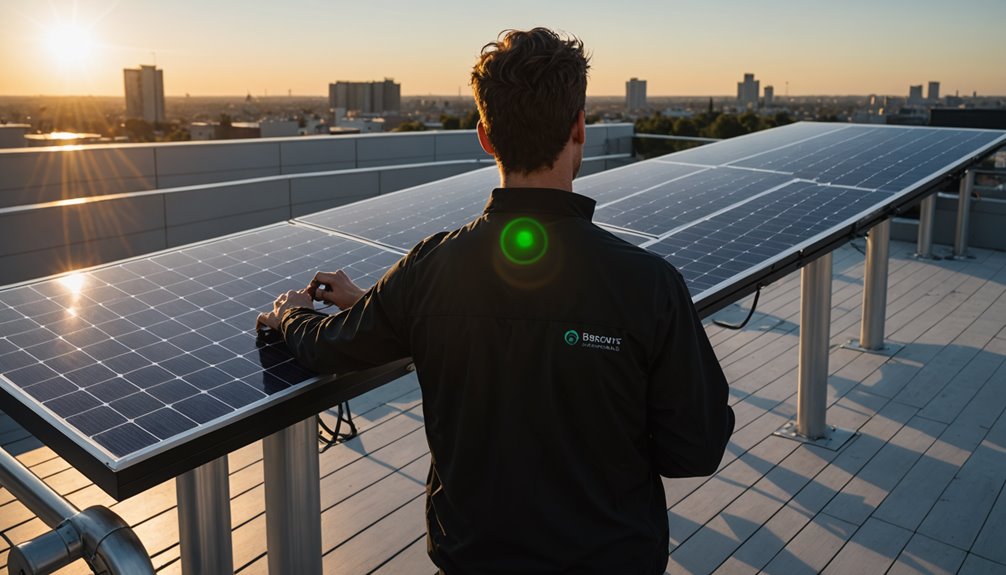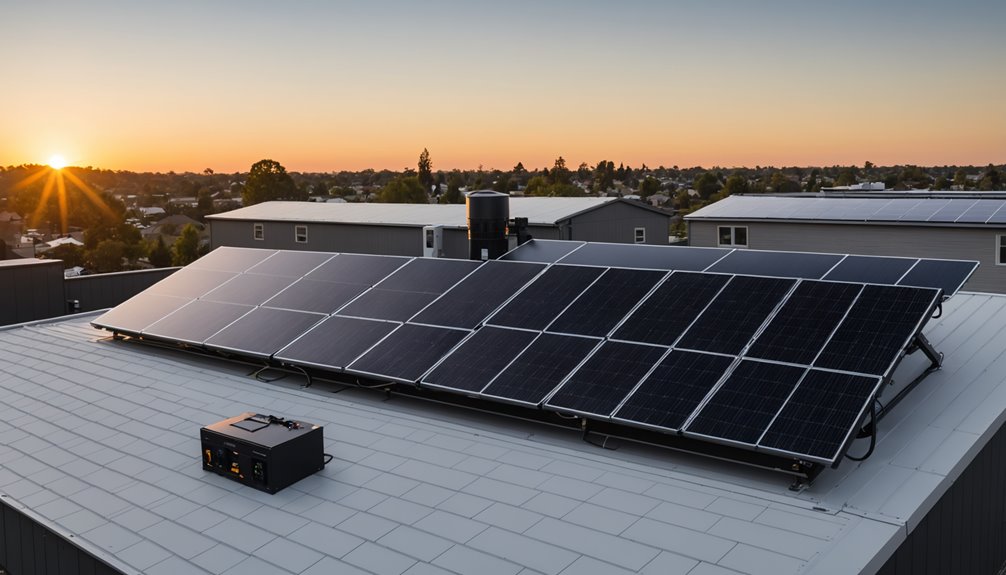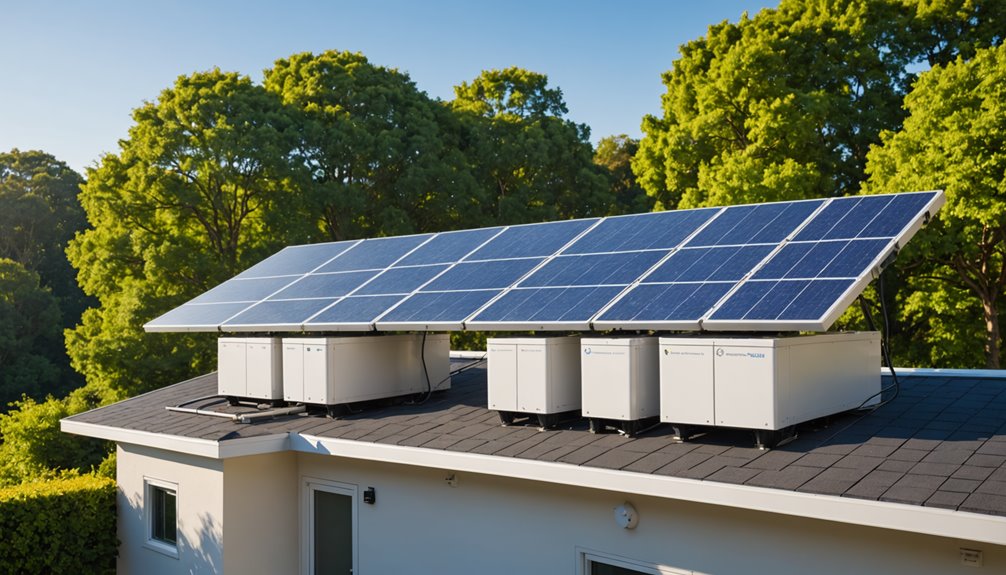
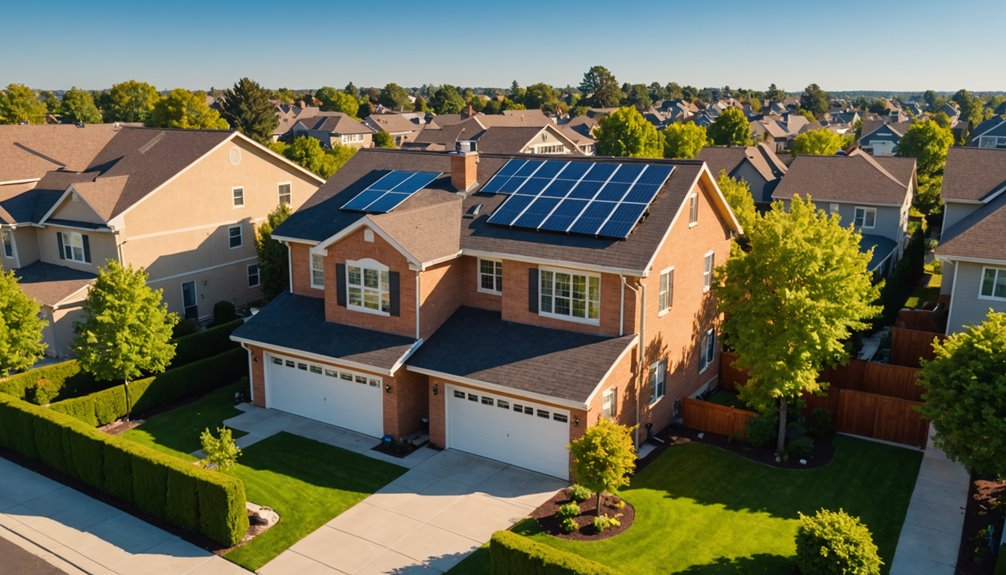
When planning a rooftop solar installation, homeowners should be aware of the 33% Roof Solar Rule, a regulation that restricts the proportion of roof surface area that can be covered by solar panels.
This rule has practical implications for system sizing, energy output potential, and overall project planning.
Familiarity with this regulation before beginning the installation process can help avoid permit rejections, required system redesigns, and potential non-compliance penalties.
The following information outlines the key aspects of this rule and its relevance to residential solar projects.
Key Takeaways
- The 33% Roof Solar Rule restricts rooftop solar panel installation to a maximum of one-third of the total roof area, a regulation primarily designed to preserve emergency access pathways for first responders.
- Coverage limits are determined by multiplying total roof area by 0.33; on a 1,200 ft² roof, this calculation yields a maximum allowable panel coverage of 396 ft².
- Installing panels beyond the 33% threshold requires additional engineering reviews, safety assessments, and permit processing, which typically result in project delays and potential structural or design modifications.
- Local authorities having jurisdiction (AHJ) and homeowners associations (HOAs) retain the authority to enforce restrictions more stringent than the 33% baseline, making early consultation with these bodies a practical step in the planning process.
- Within the constraints of rooftop coverage limitations, homeowners can consider alternatives such as high-efficiency panels, ground-mounted systems, solar carports, and battery storage solutions to optimize overall energy output.
What Is the 33% Roof Solar Rule?
The 33% Roof Solar Rule limits rooftop solar panel coverage to one-third of a structure’s total roof area. On a 1,000 ft² roof, this translates to a maximum of approximately 330 ft² of solar panel installation. The rule exists primarily to maintain clear access pathways for emergency personnel and to support adequate ventilation during fire-related incidents.
Installations that exceed this threshold are subject to more rigorous building and fire-safety evaluations, which can result in additional costs and required design adjustments. Remaining within the established limit generally streamlines the permitting process by reducing the number of regulatory reviews required.
Homeowners considering solar installation should verify the specific requirements of their local jurisdiction, as regulations can vary. Properties governed by a Homeowners’ Association may also be subject to additional restrictions beyond municipal or state-level codes. Addressing these requirements during the planning phase reduces the likelihood of delays, financial penalties, or the need for design revisions after installation has begun. Systems designed within compliant coverage limits are typically built to last over 25 years, making early planning decisions critical to maximizing the long-term performance guarantee homeowners can expect from their investment.
Why Do Fire Codes and Building Standards Require It?
Fire codes and building standards require the 33% Rule to maintain accessible rooftop pathways for firefighters during emergencies. Unobstructed access is necessary for ventilation operations and emergency response procedures. When solar panel coverage exceeds established limits, critical venting points and potential escape routes become blocked, increasing risk to both occupants and emergency personnel.
From a legal standpoint, local jurisdiction regulations enforce coverage limits to address structural concerns associated with extensive solar installations. Large panel arrays can affect wind-uplift dynamics and snow-load distribution, which may compromise a building’s structural performance under certain conditions.
Adherence to the 33% Rule also has implications for insurance coverage. Many insurers tie policy validity to building code compliance, meaning that installations exceeding permitted coverage thresholds could affect a homeowner’s eligibility for coverage or the validity of existing policies.
How Do You Calculate Your Roof’s 33% Coverage Limit?
Calculating your roof’s 33% coverage limit requires a straightforward mathematical approach. Multiply your total roof area by 0.33 to determine the maximum permissible solar panel coverage. For example, a 1,000 ft² roof yields a 330 ft² panel limit, and a 1,200 ft² roof yields a 396 ft² limit.
Exceeding this threshold introduces additional structural and fire-engineering requirements under applicable building codes. These requirements exist to maintain adequate roof access and reduce fire risk, two considerations that inform the 33% standard across many jurisdictions.
Local regulations and HOA guidelines may impose stricter coverage limits than the 33% baseline, so verifying these rules before finalizing any installation plan is a necessary step. Accurate calculations serve a functional purpose: they support code compliance, reduce the likelihood of costly post-installation assessments, and confirm that the solar installation meets established safety standards.
What Does Your Local AHJ and HOA Actually Require?
When it comes to solar installations, two entities determine what can be built: the local Authority Having Jurisdiction (AHJ) and the Homeowners’ Association (HOA). The AHJ enforces the 33% Rule to maintain firefighter access, and non-compliance with local codes can result in permit delays or additional engineering assessments. Verifying these requirements before finalizing rooftop solar coverage plans is a necessary step in the process. The HOA introduces additional considerations—while state solar access laws restrict unreasonable HOA limitations, specific guidelines still govern solar panel installations. Contacting both entities early in the planning process and confirming which AHJ and HOA rules apply helps prevent complications and unexpected costs during the project.
What Extra Costs and Delays Come With Exceeding the 33% Limit?
Exceeding the 33% roof coverage limit carries specific regulatory and financial consequences. Building safety assessments and engineering reviews become required, generating additional costs that may not have been anticipated in the original project budget. Permit approvals are subject to extended timelines, as compliance regulations mandate a higher level of scrutiny when coverage thresholds are surpassed.
Design modifications may also be necessary to bring the installation into compliance. These adjustments can include reducing the number of panels or reconfiguring the layout, both of which add labor and planning costs. Structural requirements such as wider access pathways and increased ridge vent clearance may become applicable depending on the jurisdiction.
Remaining within the 33% threshold generally allows projects to proceed through standard permitting and inspection processes, reducing both costs and approval timelines.
How Does the 33% Rule Affect Your System Size and Panel Options?
The 33% Rule establishes a ceiling on solar panel coverage relative to roof area, which has direct implications for system sizing and panel selection. Because coverage is limited to approximately one-third of the available roof surface, the total number of panels a system can accommodate is constrained from the outset.
Within that constraint, panel efficiency becomes a meaningful variable. Higher-efficiency panels generate more electricity per square foot, allowing homeowners to approach their energy production targets without exceeding the permitted coverage threshold. Standard-efficiency panels may fall short of those targets when roof space is limited, making efficiency ratings a practical consideration during system planning.
For properties where roof area is insufficient to meet energy needs under the 33% limitation, two alternatives are worth evaluating. Battery storage systems can offset some of the gap by capturing and retaining energy produced during peak generation periods. Ground-mounted systems, where site conditions allow, provide additional panel capacity independent of roof constraints.
Selecting the appropriate configuration depends on the specific roof dimensions, local permitting requirements, and household energy consumption. Assessing these factors together allows for a more accurate projection of what a compliant system can realistically deliver.
Can Battery Storage Offset What the 33% Rule Limits?
Battery storage does not increase the solar capacity permitted under the 33% rule, but it can improve the practical value of an approved installation. Because the rule limits system size relative to roof area, generation capacity is constrained. Without storage, any solar output that exceeds immediate household demand is typically exported to the grid or lost entirely. A battery system captures that surplus for use during periods of higher consumption, such as evening hours or peak rate periods.
This approach can reduce reliance on grid-supplied electricity beyond what the solar array alone would achieve. For households in areas with time-of-use pricing, drawing stored solar energy during high-rate periods can lower electricity costs compared to a solar-only setup. In regions where grid outages are frequent, battery backup also allows certain loads to continue operating when grid power is unavailable.
The financial case for adding storage depends on local electricity rates, utility export policies, and the cost of the battery system itself. Where net metering is favorable, exporting excess generation may be more economical than storing it. Where export rates are low or net metering has been reduced, storage tends to offer greater financial return. In either case, battery storage does not resolve the capacity limitation imposed by the 33% rule but can make the permitted system more effective under the right conditions.
How Do You Maximize Solar Output While Staying Within the 33% Limit?
Maximizing solar output within the 33% rule requires a systematic approach to panel selection, placement, and system design. High-efficiency solar panels produce more energy per square foot compared to standard models, making them a practical choice when roof space is limited by compliance requirements. Accurately measuring roof dimensions allows for precise panel placement that adheres to the permitted area while capturing the most available sunlight.
Beyond rooftop installations, ground-mounted systems and solar carports are viable alternatives that generate additional energy without contributing to the rooftop 33% calculation. These options can meaningfully supplement a compliant rooftop system. Battery storage adds another layer of efficiency by retaining excess energy produced during peak sunlight hours for use during periods of lower generation, improving overall system performance without requiring additional panel coverage.
Consulting with local solar installers who are familiar with regional compliance regulations is a practical step toward ensuring the system operates at its permitted maximum. Their knowledge of local codes and available equipment can help identify design choices that align with both regulatory limits and energy production goals.
Conclusion
The 33% roof solar rule establishes a defined limit on how much of a roof’s surface area can be covered by solar panels. Homeowners can calculate their coverage limits by measuring total roof area and applying the 33% threshold to determine the maximum allowable panel space. Consulting the local Authority Having Jurisdiction (AHJ) early in the planning process helps clarify how this rule is applied in a specific area, as requirements may vary by jurisdiction. Within these constraints, system efficiency can be optimized through the selection of high-output panels, which generate more power per square foot than standard models. Battery storage is another practical consideration, allowing excess energy produced during peak hours to be stored for later use. The 33% limitation reflects a regulatory framework designed to address structural and fire safety concerns, and working within it requires informed planning rather than presenting an insurmountable obstacle to effective solar system design.